
How Independent Testing Labs Shape Trust Metrics in Austria's Licensed Digital Gaming Platforms
Independent testing laboratories play a central role in establishing measurable trust metrics across Austria's licensed digital gaming sector, where operators must demonstrate compliance with technical standards before platforms receive approval from national authorities. These labs evaluate random number generators, game fairness algorithms, and security protocols through standardized testing protocols that produce quantifiable certification outcomes, and data from these evaluations feeds directly into regulatory oversight systems that track operator performance over time.
Regulatory Framework and Lab Accreditation Requirements
Austria's licensing system under the Glücksspielgesetz requires that all digital gaming platforms undergo third-party verification before launch, which means accredited laboratories conduct audits that measure compliance against specific benchmarks for randomness, payout accuracy, and data protection. Laboratories such as those recognized by the Austrian regulatory bodies must hold international accreditations including ISO 17025 for testing competence, and this accreditation process itself generates baseline trust metrics that regulators reference during license renewals and ongoing supervision.
Testing procedures cover both initial certification and periodic re-evaluations, while operators submit game files and backend systems for analysis that produces pass/fail scores along with detailed statistical reports on variance and return-to-player percentages. These reports become part of the public record that players and oversight bodies use to assess platform reliability, and the consistent application of these metrics helps maintain uniform standards across multiple licensed sites operating within the country.
Technical Testing Processes and Metric Generation
Laboratories apply mathematical models to verify that random number generators produce outcomes within acceptable deviation ranges, and they document these findings through certification documents that list exact test parameters and results. Security assessments examine encryption methods, server configurations, and transaction logging systems, which generate additional metrics related to vulnerability exposure and incident response capabilities. When platforms integrate new game titles or software updates, fresh testing cycles occur to ensure continued alignment with established benchmarks, and each cycle adds longitudinal data points that regulators monitor for trends in compliance quality.
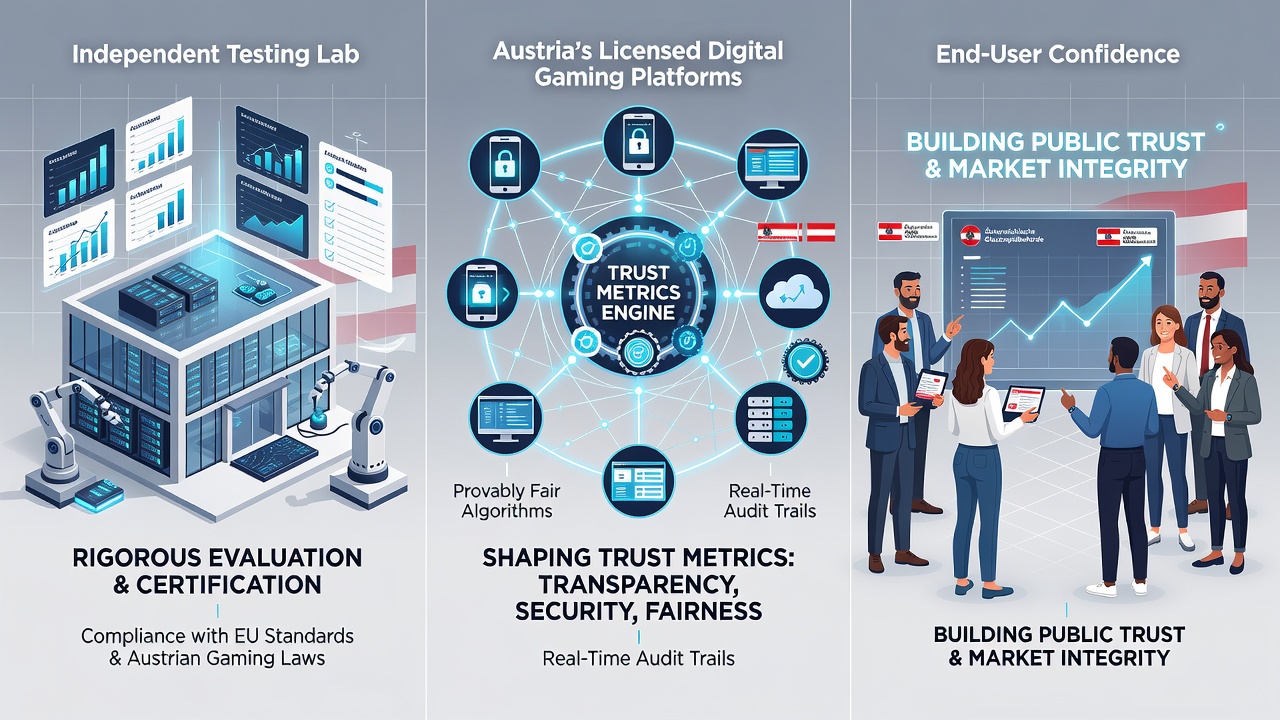
Payment system reviews form another component of the evaluation, where labs confirm that financial transactions process according to documented procedures and that funds segregation meets regulatory thresholds. These combined outputs create composite trust scores that influence how licensing authorities rank operator risk profiles, and platforms with consistently high metric values often experience streamlined approval processes for expansions or modifications. Observers note that the reliance on external laboratories reduces potential conflicts of interest while supplying regulators with standardized data sets that support evidence-based enforcement decisions.
Influence on Player-Facing Trust Indicators
Certification seals and audit summaries appear on licensed Austrian platforms as visible markers of completed testing, and these markers correlate with player engagement patterns tracked through industry analytics. When laboratories identify issues during testing, operators must address them before receiving certification, which directly affects the final trust metrics published in regulatory summaries. Research indicates that platforms displaying up-to-date certifications from recognized labs show higher retention rates in comparative studies, although the exact causal mechanisms remain under examination by academic groups focused on gambling behavior.
By September 2026, updated testing protocols are scheduled to incorporate enhanced requirements for live dealer systems and cryptocurrency transaction verification, which will expand the range of metrics collected during each audit cycle. These changes will require laboratories to develop new evaluation frameworks while maintaining consistency with existing Austrian licensing criteria, and early preparations among operators include system upgrades designed to meet the forthcoming standards without service interruptions.
Comparative Standards Across Jurisdictions
Austrian practices align with broader European technical standards yet incorporate specific national thresholds for payout verification frequency and reporting granularity. Similar laboratory-driven approaches appear in regulatory systems across Canada and Australia, where independent testing also feeds into centralized databases used for cross-jurisdictional comparisons of operator performance. European Commission documentation outlines how member states coordinate on technical testing requirements, while reports from Australian research centers provide additional context on how metric standardization affects market stability in regulated environments.
Conclusion
Independent testing laboratories continue to supply the empirical foundation for trust metrics that underpin Austria's licensed digital gaming ecosystem, and their outputs influence both regulatory decisions and platform-level operational priorities. As technical standards evolve toward the September 2026 updates, the volume and precision of collected data will increase, which will in turn refine how compliance and reliability get quantified across the sector. The structured involvement of accredited laboratories ensures that measurement remains consistent and traceable, supporting ongoing development of Austria's regulatory approach without reliance on operator self-reporting alone.